

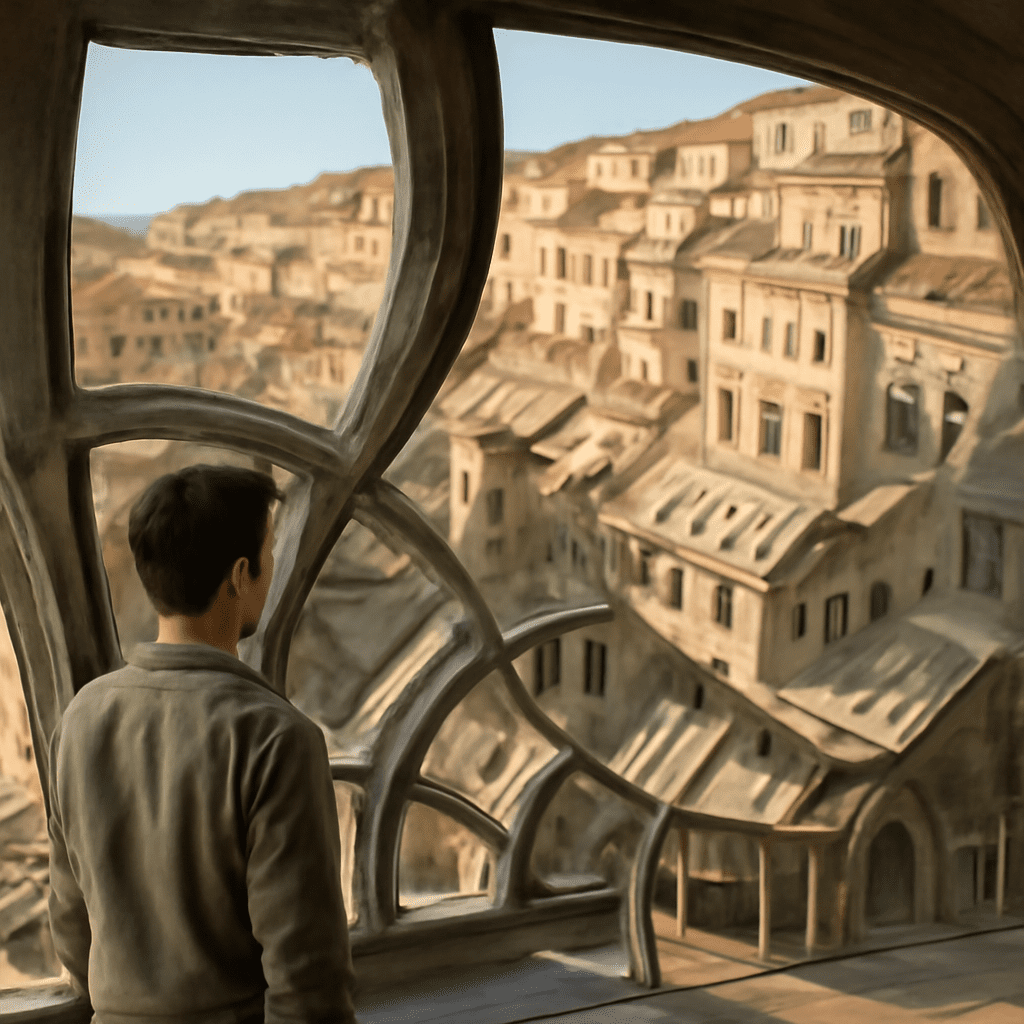
In a world governed by the conventional laws of physics and geometry, one artist dared to challenge these norms, offering us a realm where space and time intertwine in unimaginable ways: MC Escher. Known for his ability to manipulate perceptions, Escher’s Relativity stands as a masterpiece that defies traditional perspectives. In this article, you’ll discover how Escher’s Relativity artwork not only captivates the eye but also provides profound insights into the nature of spatial dimensions. Escher’s genius not only redefined art but also left an indelible mark on modern design and illustration.
Understanding the Genius of MC Escher
Who Was MC Escher?
Maurits Cornelis Escher, better known as MC Escher, was a Dutch graphic artist born in 1898. Despite his lack of formal training in mathematics, Escher’s work is renowned for its mathematical underpinnings. His ability to fuse complex geometric principles with visual art set him apart from his contemporaries. Through his mastery of perspective, he has enabled viewers to explore dimensions beyond the physical realm.
Escher’s Unique Style and Techniques
Escher’s unique style is characterized by the use of impossible constructions and explorations of infinity. He employed techniques such as tessellation, where repeated geometric shapes create complex patterns, and metamorphosis, which shows the transformation of one figure into another. These methods allowed him to create artwork that not only tricks the eye but also provokes deep contemplation about the nature of reality.
Analyzing Escher’s Relativity Artwork
The Elements of Relativity MC Escher
Relativity MC Escher is a lithograph that masterfully illustrates a world where the usual laws of gravity do not apply. In this piece, there are multiple stairways leading in various directions, creating a sense of disorientation and intrigue. By playing with perspective, Escher compels you to reconsider the logic and order of the physical universe.
Symbolism and Interpretation in Escher’s Relativity
Escher’s Relativity is rich with symbolism, inviting you to explore its deeper meanings. The figures navigating the impossible staircases represent human beings’ journey through life, where paths frequently intersect and diverge in unexpected ways. This artwork challenges your perception of reality, prompting you to reflect on the fluidity of space and time.
The Impact of Relativity Escher on Modern Art
Influence on Contemporary Artists
Escher’s Relativity has inspired countless contemporary artists, with its influence visible in various forms of modern art. Artists today continue to draw from Escher’s innovative use of perspective and geometry, incorporating these elements into their own work. The sense of wonder and mystery captured in Escher’s Relativity resonates with audiences, urging new generations of artists to explore beyond traditional boundaries.
Escher’s Legacy in Design and Illustration
Beyond the art world, Escher’s legacy is palpable in design and illustration. Designers often employ the principles seen in Relativity Escher, using optical illusions and intricate patterns to capture the viewer’s imagination. Escher’s work serves as a foundation for exploring new frontiers in visual storytelling, where the impossible becomes possible through creative design.
How to Appreciate Escher’s Relativity
Tips for Viewing the Artwork
When approaching Escher’s Relativity, take your time to absorb its complexity. Notice how your perception shifts as you follow the lines of the staircases and the figures’ movements. By viewing the artwork from different angles, you can appreciate the intricacies of its design and the subtle cues that challenge your understanding of spatial orientation.
Understanding Escher’s Visual Illusions
Escher’s visual illusions are not merely tricks; they are invitations to delve deeper into the conceptual layers of his art. To truly appreciate these illusions, consider the mathematical precision underlying each piece. Escher’s ability to bend reality with such coherence is what makes his work timeless, compelling you to question the nature of perception itself.