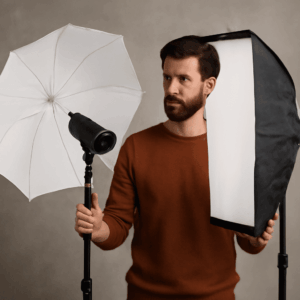

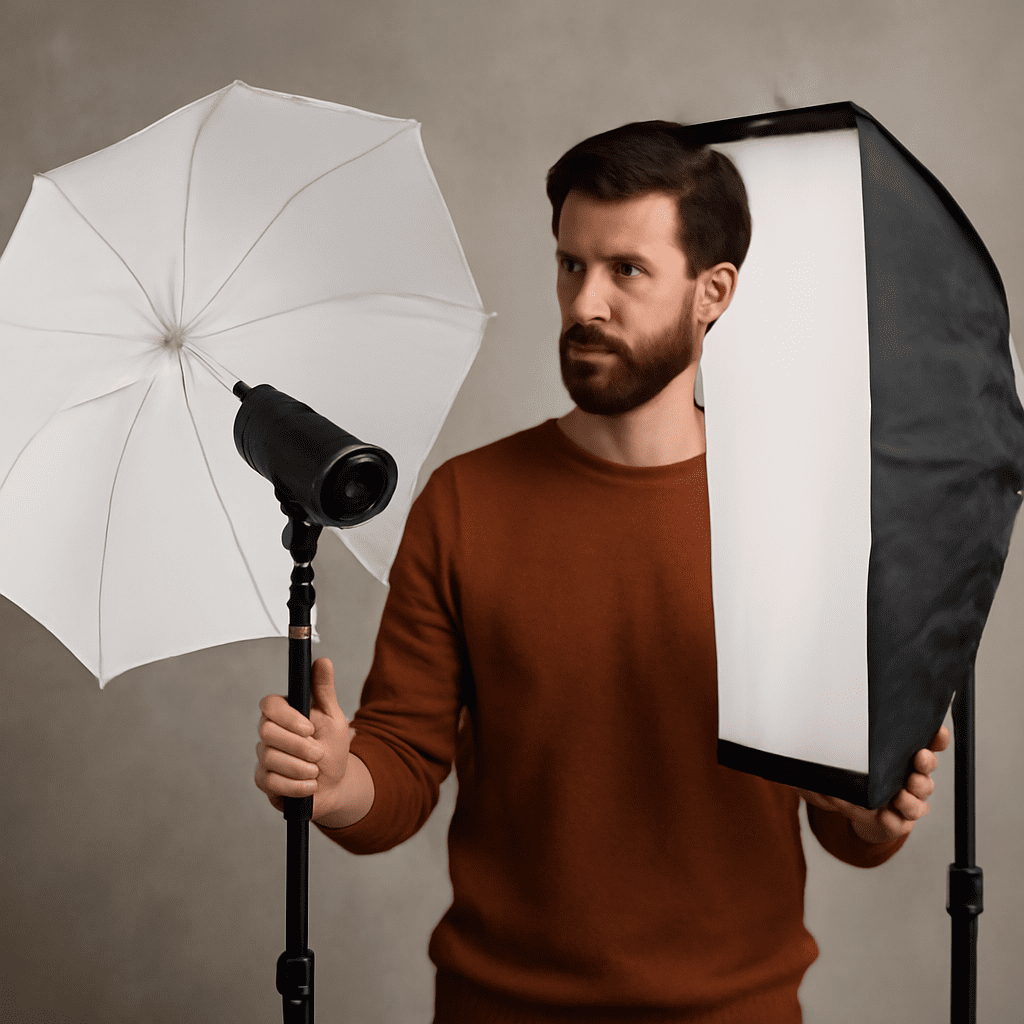
A portrait with smooth shadows and a background that stays dark starts with a deliberate lighting choice. Comparing an umbrella with a softbox helps you decide how much of the room to illuminate and how quickly you can set up. A softbox for a speedlight can give a small flash a larger apparent surface, too, making it easier to shape the light on a face.
Both modifiers spread light from a small source over a larger area. Their differences become clear when you look at shadow edges, stray light, and the space available around your subject.
What changes in the picture?
A broad light source close to the subject produces a gradual transition from highlight to shadow. A smaller apparent source produces a sharper transition. Apparent size depends on both the modifier’s dimensions and its distance: move a large source farther away and it looks smaller from the subject’s position.
That principle applies to both designs. A large umbrella placed close can create softer shadows than a small softbox placed far away. When comparing umbrella vs softbox, match their apparent sizes and positions before judging the quality of their light. Watch the shadow under the nose or the edge of a hand’s shadow on a wall.
The interior and diffusion material matter as well. A white reflective umbrella generally gives a softer, more even reflection than a silver one, while silver can add contrast and output. A softbox uses a front diffusion panel, often with an inner baffle, to spread light across its face. Its shape also affects catchlights in eyes and reflections on shiny objects: a rectangular panel produces a different reflection from a round source.
Spread and control
A shoot-through umbrella sends flash through translucent fabric toward the subject. Light also spreads backward and around the sides. A reflective umbrella points the flash into its interior and sends light back toward the subject. Both can illuminate a wide area, although shape, material, and placement affect the spread.
A softbox encloses the light on the sides and directs it through the front. That makes it easier to keep light off a nearby wall or background. Add a compatible fabric grid when you need a narrower spread; expect some loss of output and check the result on camera. A grid controls where light goes, while the size and distance of the illuminated front still influence shadow softness.
Think of the choice between an umbrella and a softbox in terms of the room as well as the subject. In a small white room, even a directed source can bounce off the walls and fill shadows. Move the light and subject away from a wall, or use a dark flag beside the light, if that reflected fill is too strong.
Setup, space, and location
An umbrella usually opens quickly and slides into a holder on a flash bracket or light head. A conventional softbox may require assembling rods, fitting diffusion panels, and attaching a compatible mount. Some models open like umbrellas, so check the actual design if setup time matters.
A shoot-through model can sit close to a subject, but its shaft and the flash position can affect where you place the stand. A reflective model needs room for the flash to point into the bowl. A softbox also needs clearance for its depth and mount. Measure the available space before choosing a large modifier for a small room.
Outdoors, either modifier can catch wind. Weight the stand with sandbags and have an assistant hold it when conditions call for one. If the wind makes the setup unstable, take the modifier down. Check that the modifier is rated for your light, especially with hot continuous lamps, and follow the manufacturer’s clearance instructions.
The hybrid option
An umbrella softbox combines a folding umbrella-style structure with diffusion and, depending on the design, an enclosed or covered back. An umbrella fitted with a softbox diffuser covers the reflective bowl; a translucent model can use a back cover. These are different configurations, so inspect where the flash sits and which accessories are included.
An umbrella-style softbox can pack down quickly while giving you a diffused front surface. It is a practical middle ground when setup speed matters but you want more control over spill than an open shoot-through design provides. Check whether a grid is available for the specific model if keeping light off the background is central to the shot.
Speedlight Softbox: Size and Mounting
A speedlight softbox can be a compact attachment on the flash head or a larger unit supported by a bracket and stand. The small camera-mounted version is convenient for moving through an event, but its front surface remains relatively small at portrait distance. Its effect on shadow softness will be modest compared with a larger source placed close to the subject.
For a more noticeable change, take the flash off camera and mount a larger speedlight-compatible softbox on a stand. Use a bracket that supports the modifier’s weight instead of putting strain on the flash’s hot shoe. A wireless trigger lets the camera fire the flash; verify that the trigger and flash are compatible and that the flash head fits the bracket.
Diffusion absorbs some light. If the flash cannot deliver enough exposure, move the modifier closer, raise ISO, open the aperture, or increase flash power within its limits. A speedlight inside a softbox may also recycle more slowly at higher power, so allow time between frames.
Test and adjust the light
Set your subject about 4 feet from the background as a starting arrangement, with the light slightly above eye level and to one side. Set the camera to manual exposure and take a frame without flash. Adjust the ambient exposure until it supports the intended look, then turn on the flash and make a test frame. Stay within your camera’s flash sync limit unless you deliberately use a compatible high-speed sync mode.
Examine the face, shadow edge, background, and catchlight. If facial shadows are too hard, bring the modifier closer or use a larger one. If the background is too bright, aim the source away from it, move the subject farther forward, or add a grid or flag. Adjust flash power after moving the light, because distance changes exposure as well as apparent size. Check the histogram for clipped highlights.
For a quick group setup with broad coverage, choose an umbrella sized to cover the group evenly. For a portrait where a dark background and controlled spill matter, choose a softbox with a suitable mount and optional grid. If you travel often and need a compromise, compare umbrella-style softboxes by packed size, assembly, and available accessories before deciding.